

Turkish sea bass and sea bream producers have warned that prices will remain in the current range of €5.00-€6.00 per kilo or will increase slightly due to restrictions in the pipeline of some new farms.
Hilay Agaoglu, export manager of Kilic, the world’s largest producer and exporter of sea bass and sea bream with an annual production of 75,000 tonnes, said Turkish prices could “go up a few more cents” after rising 15-23% since the start of 2022.
“I think prices will be more or less the same as today, although they could go up,” he said at the Seafood Expo in Barcelona.

Hilay Agaoglu, Export Manager at Kilic
According to data from the European Market Observatory for Fisheries and Aquaculture (EUMOFA), since the beginning of 2022, the average import price for fresh and whole Turkish seabass in the EU has increased by 15% from week 16 to €5.76 per kilo. Seabream prices have also jumped by 23% to €4.77 per kilo (see charts below).
Agaoglu said that prices have increased while production in Turkey has been stable. “The reason is that there is demand and production has been more stable in the last two years. In the last month, especially for seabream, we have seen a significant increase in prices.”
EU seabass imports from Turkey
Fresh and chilled product volume

EU Seabream Imports from Türkiye
Volume of Fresh and Chilled Product

Tolga Oruk, marketing and sales coordinator at Agromi, the third-largest producer of bas and bream with 24,000 tonnes of production, said demand was strong from “all regions”.
Like Aghaoglu, he confirmed that prices in Europe – including freight and freight – were 5 euros per kilo for bream and 6 euros for bas.
“When the war started a few months ago, our exports to Russia and Ukraine stopped, but we still have a lot of demand from different places, such as the Middle East and Europe. And prices could increase again,” he said.
Oruk outlined the view that producers in Turkey were taking a “more conservative” approach to production growth after a few turbulent years.
In late 2018, Agromi filed for bankruptcy and sought support after a major investment program dating back to 2014 that would have increased annual production to 24,000 tons. After prices fell to €3.00-3.50 per kilo, the company was put into administration.

Tolga Oruk, Marketing and Sales Coordinator at Agromi
“At the end of the day, we have to make some profit,” said Oruk. “That’s why things have changed today. The mentality of producers is completely different today.”
Turkey’s beet and beet export data suggests that the country’s production growth is slowing. According to data analysis by the International Trade Center (ITC), the country’s fresh and whole beet and beet exports grew by 8.2% and 2.8%, respectively, between 2018 and 2021, compared to 18% and 19% in 2015-2018.
This means that annual exports of fresh beet and beet increased by 16,200 and 19,900 tons, respectively, between 2015-2018. But three years later, exports increased by only 3,500 and 13,000 tons (see charts).
Türkiye’s fresh and whole seabream exports, 2012-2021

Türkiye’s whole and fresh civet exports, 2012-2021

Turkey’s data does not detail frozen sea bass and bream exports in its classification, which could be part of the reason. Agaoglu said his company’s frozen sales jumped during the pandemic and now sell more frozen fish than fresh.
“Our sales channels have changed. Instead of fresh products being sold in fish markets, most of the products go to retail. Our retail sales have increased by 20 percent,” he added.
Inflationary pressure means demand for retail packages is strong, even as restaurants reopen.
Dan Desnica, head of production at Kromaris, a sea bass and bream producer in Croatia, is aiming to produce 12,000-13,000 tons this year. Despite higher prices, his company has no plans to increase its production of sea bass and bream, he said.

Dan Desnica, head of production at Kromaris, a producer of bream in Croatia.
“We are competing with the tourism industry for space, so there is not much room for growth,” he said.
The company is diversifying its species, growing species such as bream, dentex and amberjack.
“Our advantage over Turkish and Greek producers is that we can deliver fresh bream to the main markets in Italy by truck within 24 hours,” he said. “But the reason for the change in species is the competition with Greece and Turkey, as well as domestic competition. We see a good opportunity to offer our customers a variety of products.”
Kilic still looking for growth
Despite the consensus on keeping (production) stable, companies are still eager to grow. Kilic has increased its production by 10-15% in the past few years and expects to continue on this path, Agaoglu said.
“We will definitely grow, because Mr. Kilic, the owner of the company, does not like to stand still. Our company is family-run and has no other shareholders. He likes to work and develop the business,” he added.
The company is doing this production growth in parallel with the search for new species, such as hirame, a fish similar to halibut. “Everything depends on market demand. But there are other species that we are working on, some of which are confidential.”
Producers will have to control their ambitions, Uruk warned, due to rising inflation for both aquaculture inputs and consumer markets.
“We will try to increase production capacity, but not to the high figures of previous years, because we have obstacles ahead. Feed accounts for 70% of our total costs. “We have access to fewer sources of fishmeal, and at the same time, wild catches are declining.”
Fresh Cbass/Cbrim figures at a glance:
· EU Cbrim imports from Turkey in 2022 (as of week 16): 13,021 tonnes, up 2% year-on-year
· EU Cbrim imports from Turkey in 2022 (as of week 16): 6,735 tonnes, up 15%
· Average EU Cbrim import price from Turkey (week 16): €4.77/kg, up 21%
· Average EU Cbrim import price from Turkey (week 16): €5.76/kg, up 32%
Turkey’s economic turmoil and Russia’s invasion of Ukraine also pose risks. In a recent Reuters poll, annual inflation in Turkey hit 68% in April. The last time inflation exceeded that level was in February 2002, when it was 73%.

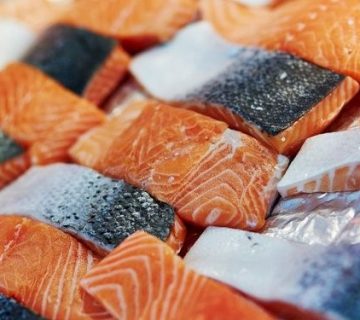
Kilich product frozen sea bream fillet in retail.
Uruk said that while inflation will affect Türkiye’s domestic economy, he does not foresee many consequences for the country’s aquaculture producers.
“We hedge our risk because we sell our products in dollars or euros,” he said. We also buy all raw materials in dollars or euros. Of course, this inflation may affect domestic sales and food businesses, but you know, seafood is not very popular in Türkiye.”
Meanwhile, although his company’s sales to Russia have declined, he didn’t anticipate the spillover effect. “For Russia, the shipment of 12 to 13 trucks a week was just [stop and go]. Four to five trucks were also sending frozen products. This volume of sending has now decreased by 80%. “Many systems such as money transfer and transportation stopped.”
He added that sales to Ukraine have been “completely stopped” but “have no effect on the market”.
Aghaoglu said that Russia is one of the company’s main markets, but he has seen better sales. “We didn’t stop selling. “Initially we reduced the shipment, but now they [Russian buyers] are trying to return to the previous conditions.”

Farmed fish products with shell packaging.
According to the data obtained from ITS, in 2021 Türkiye exported 3,600 tons of fresh bass and 4,000 tons of fresh bream to Russia. These figures are equivalent to 8% and 7% of the export of these products.