

“Supercooling reduces packaging and distribution costs by approximately 70 euros per kilogram for truck transport to Europe,” said Nofima scientist Odin Orsen. “If all Norwegian salmon production was supercooled before transport, the industry could save 1.5 billion kroner (142,963,245 euros) in logistics costs every year,” said Nofima scientist Odin Orsen.
Researcher Børn Tor Rutaback, with supercooled salmon. Rutaback and his colleagues at Nofima studied the economic and environmental impacts of supercooling salmon.
“Supercooling eliminates the need for ice in the boxes, allowing more salmon to fit in each box,” says Nofima scientist Børn Tor Rutaback. More fish per box reduces the need for transportation, energy consumption and handling costs. This also significantly reduces the need for packaging.”
The Fisheries and Aquaculture Research Fund (FHF) actually commissioned a project entitled “New methods for better shelf life and more environmentally friendly transport of salmon products.” The researchers in the report are: Odan Iverson and Björn Tor Rottabak from Nofima and Fredrik Ziegler from the Swedish Rice Research Institute.
Supercooling and freezing
The study is about the economic and environmental impacts of supercooling salmon. The fish tissue does not freeze until it reaches a temperature between -0.5 and -1.5 degrees Celsius. When the fish is rapidly cooled to a temperature between 0 degrees Celsius and freezing, this phenomenon is called supercooling. Cooling is achieved using supercooled liquid, dry ice or freezing technology. After supercooling, the product is packaged and transported, and the temperature is continuously maintained as close to 0°C as possible.
These effects are illustrated by two important product shipping flows: salmon to Europe by truck and salmon to Asia by air. Supercooling leads to encouraging future prospects for both the salmon industry and the environment.
First, money:
It can save 1 billion kronor in transportation costs. The savings in the air transport sector are even greater, approximately 2.70 (kronor) per kg, or almost half a billion for the entire industry.”
By using less ice, the industry saves on the cost of producing, keeping the ice cool and especially transporting it to market.
“Without ice, each box can hold more fish,” says Odan Iversen. “And so more fish can be put on vehicles and planes. Consequently, fewer trucks are needed. It also reduces packaging and shipping costs.”
He notes that supercooling can reduce packaging and handling by up to 20%. That means about 15,000 truckloads of salmon are taken off the road. The boxes also have to be transported from the box factory to the processing plant.

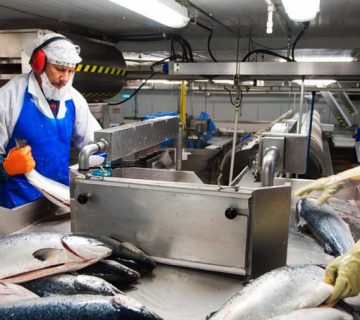
Salmon processing. Ultracooling salmon can reduce greenhouse gas emissions during processing.
Reduced energy consumption
Ultracooling also saves energy costs before and during shipping. Cooling the tank consumes 7 kWh more energy per tonne of salmon produced. The company also saves 21 kWh per tonne of ice production, resulting in a reduction in electricity consumption of 14 kWh per tonne of salmon. Salt consumption increases – 52.5 kg per tonne of salmon – and 1,500 litres more water is used per salmon. All environmental impact calculations are based on 26 kg of salmon per box instead of 21.5 kg.

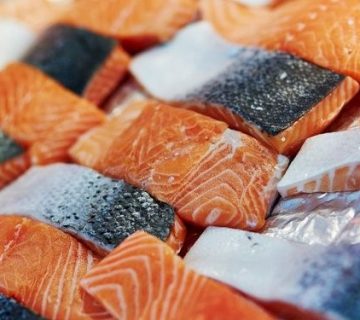
Farmed salmon fillets. If supercooling is used, greenhouse gas emissions associated with the slaughterhouse, packaging and transportation of salmon can be greatly reduced.
“Not using ice means there is no runoff from the truck,” says Born-Tor-Rotabaek. “That’s a big advantage in terms of road safety, but we don’t try to put a value on it.”
Less runoff is also very good for environmental accounts, but it’s a small factor compared to the other benefits of supercooling.
Reduced greenhouse gas emissions
The report also argues that greenhouse gas emissions associated with the slaughterhouse, packaging and transportation of salmon can be greatly reduced. It is estimated that these emissions could be reduced by approximately 15 percent for truck transport to Europe and 17 percent for air transport to Asia.
“Transportation to market accounts for only 1 percent of the total greenhouse gas emissions for transporting salmon by truck to Europe, while feed accounts for almost 70 percent,” Odan Iversen points out. “On the other hand, when the fish is shipped by plane to Asia, this transport accounts for more than half of the emissions. So a 17 percent change has a large impact on total emissions, reducing them by about 8 to 9 percent.”